
Blog

Your blog category

Blog

Dubai Family Visa for Freelancers and Self-Employed Residents: Requirements and Application Guide

Dubai Family Visa for Freelancers and Self-Employed Residents: Requirements and Application Guide Working as a freelancer in Dubai offers flexibility. You can work with different clients, manage your own schedule, and build a business without following the traditional employment structure. But once you settle in the UAE, you may have another important goal: bringing your spouse and children to live with you. The good news is that freelancers and self-employed residents may be eligible to sponsor their family members, provided they meet the relevant immigration requirements. The process depends on the type of residence visa you hold, your financial circumstances, and the documents you can provide. This guide explains the Dubai freelance family visa requirements, the documents you may need, and how to sponsor family on freelance visa in Dubai. Can Freelancers Sponsor Their Family in Dubai? Can Freelancers Sponsor Their Family in Dubai? Yes, freelancers and self-employed residents may be able to sponsor eligible family members if they hold an appropriate UAE residence permit and satisfy the applicable sponsorship conditions. However, having a freelance permit alone does not automatically qualify you to sponsor your family. Your residence status, income, accommodation, and proof of relationship may all be relevant. For example, a freelancer holding a Green Residence permit may qualify under the rules applicable to that residence category. Someone holding a different type of freelance or self-sponsored residence visa should check the conditions that apply to their specific permit. Before starting the application, confirm your eligibility with the relevant authority, such as the General Directorate of Residency and Foreigners Affairs (GDRFA) in Dubai. Dubai Freelance Family Visa Requirements Understanding the Dubai freelance family visa requirements before collecting documents can help avoid unnecessary delays. 1. Valid UAE Residence Permit The sponsor generally needs a valid UAE residence permit. Depending on your circumstances, this could be a Green Residence permit for freelancers and self-employed individuals or another eligible residence category. If your residence permit is close to expiry, check whether it should be renewed before applying for your family’s residence permits. 2. Proof of Sufficient Income Financial eligibility is an important part of family sponsorship. The UAE government generally states that a resident must earn at least AED 4,000 per month, or AED 3,000 plus accommodation, to sponsor eligible family members. For freelancers, demonstrating income may require more preparation than it does for salaried employees. You may need bank statements, client contracts, invoices, financial records, or other evidence accepted by the relevant authority. These general family-sponsorship income conditions should not be confused with the separate eligibility criteria for obtaining a Green Residence permit as a freelancer. The Green Residence route has its own requirements, including qualifying professional credentials and income or financial-solvency evidence. 3. Suitable Accommodation You may need to demonstrate that you have suitable accommodation for your family. Depending on the application, accepted evidence may include a registered tenancy contract or other housing documentation. Check the current requirements for your specific visa category rather than assuming that every type of accommodation document will be accepted. 4. Proof of Family Relationship You must provide official documents establishing your relationship with the family members you wish to sponsor. For a spouse, this generally means a valid marriage certificate. For children, birth certificates are commonly required. Documents issued outside the UAE may need attestation and, where applicable, certified Arabic translation. How to Sponsor Family on Freelance Visa in Dubai The application process can generally be divided into several stages. Step 1: Check Your Residence Category Start by confirming whether you hold a Green Residence permit, a freelance residence visa issued through a free zone, or another residence category. This distinction matters because different authorities and visa categories can have different procedures. Do not rely solely on the name of your freelance licence when determining your family-sponsorship eligibility. Step 2: Prepare Your Documents Collect your residence permit, passport copy, financial evidence, accommodation documents, and proof of relationship. Review every document carefully. Differences in names, dates of birth, or passport details may lead to requests for corrections or additional evidence. If your marriage or birth certificate was issued in another country, confirm the applicable attestation and translation requirements before submitting it. Step 3: Submit the Family Entry Permit Application Depending on your circumstances, you may need to apply for an entry permit for your spouse or children through the relevant official channel. Dubai applications can be handled through GDRFA’s digital services or other authorized channels, where applicable. The exact procedure depends on whether your family members are outside the UAE or already living in the country. Step 4: Complete Residence Formalities After the necessary approvals, your family members may need to complete the remaining residence procedures. These can include medical fitness examinations for applicants aged 18 or older, Emirates ID formalities, and health insurance requirements where applicable. Follow the instructions issued by the relevant authority and observe any deadlines attached to the entry permit. Step 5: Receive and Maintain the Residence Permits Once the application is approved and the required formalities are completed, the family residence permits can be issued. Keep copies of all approvals and identification documents. You should also monitor the expiry dates of your own residence permit and your family members’ permits, as their residence status is generally linked to the sponsor’s status. What Documents Should Freelancers Prepare? Although the exact checklist varies, it is useful to prepare the following documents before starting: Passport copies for the sponsor and family members. Valid UAE residence permit and Emirates ID details, where applicable. Recent photographs meeting the application specifications. Freelance permit, licence, or other relevant business documentation. Bank statements and evidence of income or financial capacity. Registered tenancy contract or other accepted accommodation evidence. Attested marriage certificate for a spouse. Attested birth certificates for children. Health insurance and medical fitness documents when required. The authority may request additional documents based on the sponsor’s visa category and family circumstances. Common Mistakes to Avoid Freelancers sometimes assume that a valid residence permit automatically gives them permission


Blog

Dubai Employment Visa Process: Complete Guide for Foreign Workers

Dubai Employment Visa Process: Complete Guide for Foreign Workers Getting a job in Dubai can be an exciting opportunity for foreign workers looking to develop their careers, earn a competitive salary, and gain international work experience. However, before moving to the UAE, it is important to understand the visa process, required documents, employer responsibilities, and steps involved in obtaining permission to work legally. The Dubai employment visa process is generally managed by the employer, who coordinates the necessary work permit and residence procedures. Although many steps can be completed online, workers may still need to attend medical examinations and complete Emirates ID formalities after arriving in the UAE. This guide explains how to apply for Dubai employment visa for foreign workers, what documents are generally required, and what applicants should know before accepting a job offer. What Is a Dubai Employment Visa? A Dubai employment visa allows an eligible foreign national to enter and reside in Dubai for employment with an authorized employer, subject to the applicable immigration and labour requirements. For most private-sector employees, the process involves obtaining a work permit, arranging entry into the UAE when required, completing medical fitness procedures, and securing a residence permit and Emirates ID. The employer normally sponsors the standard employment visa and initiates the official application. The precise process can differ depending on whether the company operates on the UAE mainland or in a free zone. Dubai Work Visa Requirements Before starting the application, foreign workers should understand the Dubai work visa requirements that may apply to their particular job and employer. Common requirements include: A valid passport, generally with at least six months of validity. A recent passport-style photograph. A genuine job offer from an eligible UAE employer. An employment offer or contract completed through the appropriate official process. Educational certificates or professional qualifications, where required. Professional licences or approvals for regulated occupations. Medical fitness clearance and Emirates ID procedures for residence formalities. Some qualifications may need attestation or recognition, depending on the position and applicable authority. Workers should confirm these requirements before paying for document preparation or attestation. Meeting the basic requirements does not automatically guarantee approval. The employer must also satisfy the relevant licensing, eligibility, and work-permit conditions. How to Apply for Dubai Employment Visa for Foreign Workers The process usually follows several stages. Step 1: Receive and Verify the Job Offer The first step is receiving a formal job offer from a UAE employer. Read the offer carefully and check the job title, salary, working hours, benefits, workplace, and employment conditions. Make sure the employer’s identity and contact information are genuine. Where applicable, verify the offer through the relevant UAE authority. Be cautious if someone promises a guaranteed visa or asks for suspicious payments in exchange for a job. Step 2: Employer Applies for the Work Permit Once the offer is accepted and the necessary documents are ready, the employer or its authorized representative submits the work-permit application through the relevant channel. For eligible mainland private-sector employers, this commonly involves the Ministry of Human Resources and Emiratisation (MOHRE). Free-zone companies generally follow the procedures of their respective free-zone authority. The authority reviews the application and may request additional information before making a decision. Step 3: Entry Permit or Entry Arrangements After the necessary approvals, the employer arranges the applicable entry permit or immigration procedure. This allows the worker to enter the UAE for the purpose authorized by the permit. Workers already in the UAE may need a status-change procedure rather than an entry permit from abroad. The correct route depends on the applicant’s current immigration status and the relevant authority’s rules. Step 4: Travel to Dubai and Complete Medical Formalities After entering the UAE, the employee completes the required post-arrival procedures. These commonly include a medical fitness examination and Emirates ID application formalities. Biometrics or other in-person steps may be necessary. Therefore, even when the application is initiated online, the entire process may not be completed remotely from the worker’s home country. Step 5: Obtain the Residence Permit and Finalize Employment Records Once the required checks and approvals are completed, the employer coordinates the residence permit and remaining employment documentation. The worker should keep copies of the employment contract, residence permit, Emirates ID information, and other important records. The validity period depends on the visa category and applicable rules. Can the Dubai Employment Visa Process Be Completed Online? Yes, many parts of the process can be completed online. Employers can submit work-permit applications, upload documents, pay applicable fees, and follow application progress through authorized government or free-zone channels. The UAE’s Work Bundle platform also integrates several employment and residency procedures for eligible employers. However, online processing does not mean every applicant can independently submit a standard employment visa application. The employer or an authorized representative normally manages the official filing. Medical examinations, biometrics, and other procedures may still require the worker’s physical presence. How Much Does a Dubai Employment Visa Cost? The total cost varies according to the employer, permit category, company location, insurance arrangements, and applicable government charges. Possible expenses include work-permit and residence processing fees, medical fitness examinations, Emirates ID issuance, health insurance, document attestation, and translation where required. There is no single fee that applies to every foreign worker. Applicants should ask for an itemized explanation of any charges and confirm them with the relevant authority. Importantly, UAE labour rules generally place recruitment and employment costs on the employer. Workers should be cautious if an employer or intermediary asks them to pay substantial recruitment charges in exchange for a job or visa. How Long Does the Process Take? Processing times depend on the application category, employer eligibility, document accuracy, security checks, and the relevant authority’s workload. An application with complete and accurate documents may progress more smoothly than one requiring corrections or additional approvals. Medical examinations, Emirates ID procedures, and residence formalities also affect the overall timeline. Applicants should avoid making non-refundable travel arrangements until the employer confirms that the necessary approvals and entry

Blog

Dubai Investor Visa for Free Zone Company Owners: Requirements, Costs and Application Process

Dubai Investor Visa for Free Zone Company Owners: Requirements, Costs and Application Process Dubai has become an attractive destination for entrepreneurs who want to establish a business, expand internationally, or build a presence in the Middle East. One reason is the availability of free zone company structures that allow foreign investors to own businesses in many sectors. However, registering a company and obtaining permission to reside in the UAE are two different processes. If you have established a company in a Dubai free zone, you may be eligible to apply for an investor or partner residence visa, subject to the applicable free zone and immigration requirements. This guide explains the Dubai investor visa requirements, the application process, the documents to prepare, and the expenses that free zone company owners should consider before applying. What Is a Dubai Investor Visa for Free Zone Company Owners? A Dubai investor visa generally refers to a residence visa pathway available to eligible individuals who own shares in, or have an investment interest in, a UAE company. Depending on the free zone and the company’s legal structure, the relevant category may be described as an investor visa or partner visa. This option can be useful for foreign entrepreneurs who want to manage their business, establish a long-term presence in Dubai, and explore opportunities in international markets. The visa is not automatically issued when a company is registered. Applicants must satisfy the relevant immigration requirements, and the company must maintain the necessary licence and registration. It is also important to distinguish an ordinary investor or partner residence visa from the UAE Golden Visa. The Golden Visa is a separate long-term residency category with specific investment and eligibility conditions. Dubai Investor Visa Requirements Before starting the application, review the requirements of your chosen free zone. Although the exact rules differ, applicants should generally be prepared to provide the following documents: A valid passport, usually with at least six months of validity. Recent passport-size photographs that meet the required specifications. A valid free zone trade licence. Company incorporation or registration documents. Proof of shareholding, such as a shareholder certificate or partnership documentation. An establishment card or other company immigration records, where applicable. An entry permit or current UAE residence status, if relevant. Medical fitness examination results and Emirates ID application details, as required during the process. Additional declarations, approvals or supporting documents requested by the relevant authority. Some free zones may require additional paperwork depending on the business activity, company structure and visa category. For example, a shareholder applying as a company investor may need evidence that the individual is officially listed as an owner or partner. A trade licence alone may not establish every detail required for the application. Preparing the documents in advance can help reduce delays caused by missing information, inconsistent company records or expired documents. How to Apply for Dubai Free Zone Investor Visa Understanding how to apply for dubai free zone investor visa can help business owners organize the process more efficiently. The application usually involves several stages. Step 1: Establish Your Free Zone Company If you have not registered your business yet, choose a free zone based on your intended business activity, licensing requirements, office needs and budget. Dubai has free zones serving industries such as technology, trading, consulting, media and logistics. Each authority has its own registration procedures and available visa packages. If your company is already registered, check that its trade licence and other required records are current. Step 2: Confirm Your Investor or Partner Status Review your company’s incorporation documents to confirm that your ownership or partnership is properly recorded. Ask the relevant free zone authority which visa category applies to your circumstances. Do not assume that every shareholder automatically qualifies for an investor visa or that all free zones use identical eligibility rules. Step 3: Prepare the Required Documents Collect your personal identification documents and company records. Check that your name, passport details, ownership information and company details are consistent across the documents. If any documents require certification, translation or additional verification, arrange this before submission. A document checklist can be particularly helpful when coordinating the application from outside the UAE. Step 4: Submit the Application Through the Relevant Channel Many free zones provide online portals or application assistance for eligible investor and partner visa applications. Depending on the arrangement, you may submit documents through your free zone authority or the appropriate immigration channel. The relevant authority will review the application and may request additional information. Online submission does not necessarily mean the entire process can be completed remotely. Medical examinations, biometric enrolment or other steps may require attendance in person. Step 5: Complete the Residence Formalities After the relevant entry or immigration approval, complete the outstanding requirements, which may include a medical fitness examination, Emirates ID procedures and residence permit issuance. Follow the instructions provided by the authority handling your application. Do not make travel or relocation plans based solely on an application receipt or an unapproved application. Free Zone Visa Cost Dubai: What Should You Budget For? The free zone visa cost dubai varies according to the free zone, visa category, applicant’s location, processing options and the services included in the package. The total budget may include: Company registration and trade licence charges, if the company is not yet established. Investor or partner visa processing fees. Entry permit or status-change charges, where applicable. Medical fitness examination fees. Emirates ID and residence permit charges. Health insurance, where required. Establishment card or company immigration administration charges. Optional document preparation or professional assistance fees. For illustration, Dubai World Trade Centre Free Zone published an August 2025 fee schedule listing investor or partner visa processing at AED 3,500 for applicants outside the UAE using normal medical processing, and AED 5,000 for applicants inside the UAE using normal medical processing. These are examples from one free zone, not universal prices, and additional charges or changes may apply. Before paying, request an itemized quotation that separates government charges, free zone fees,

Blog

EB-1A Final Merits Determination: Why Meeting Three Criteria May Not Be Enough

EB-1A Final Merits Determination: Why Meeting Three Criteria May Not Be Enough Many professionals applying for an EB-1A green card believe that meeting three of the ten eligibility criteria is enough to secure approval. While meeting at least three criteria is generally required under the evidentiary framework, it does not automatically mean that USCIS will approve the petition. The important factor that applicants need to understand is EB1A final merits determination. At this stage, USCIS evaluates the evidence as a whole to determine whether the applicant has demonstrated extraordinary ability and sustained national or international acclaim. Understanding this process can help applicants prepare a stronger petition, identify weaknesses in their supporting documents, and present their achievements more effectively. What Is the EB1A Final Merits Determination? The EB1A final merits determination is the second stage of the evidentiary review used by USCIS to evaluate an extraordinary ability petition. During the initial stage, USCIS examines whether the applicant has satisfied at least three of the ten regulatory criteria or has established a qualifying one-time achievement, such as a major internationally recognized award. However, satisfying this initial requirement is not the end of the process. USCIS then considers whether the complete record demonstrates that the applicant belongs to the small percentage who have risen to the very top of their field and have achieved sustained national or international acclaim. This distinction is important because an applicant may submit evidence that appears to satisfy three individual criteria but still fail to establish extraordinary ability when the evidence is considered together. In simple terms, meeting the minimum evidentiary threshold and proving eligibility for EB-1A classification are related but separate questions. EB1A Final Merits Determination 3 Criteria: Why the Number Alone Is Not Enough When researching the EB1A final merits determination 3 criteria requirement, applicants should understand that the three-criteria threshold is not a guarantee of approval. For example, consider a software engineer who has published scholarly articles, participated in peer review, and received professional recognition. These achievements may be relevant to the applicable criteria, depending on the evidence and circumstances. However, USCIS may still examine whether the applicant’s accomplishments demonstrate recognition beyond ordinary professional participation. Publishing articles does not automatically establish sustained acclaim. Similarly, completing peer reviews does not necessarily demonstrate that an individual has risen to the top of their field. The same principle applies to entrepreneurs, scientists, researchers, business executives, and other professionals. The purpose of the final merits review is to evaluate the significance of the applicant’s achievements in context. It is not simply a matter of counting documents or checking off three boxes. Applicants should therefore focus on the quality, credibility, and overall significance of their evidence rather than relying on the number of criteria alone. What Evidence Can Strengthen the Final Merits Review? A well-prepared petition explains how the applicant’s achievements demonstrate extraordinary ability. The most useful evidence will depend on the individual’s profession and career history. 1. Original Contributions of Major Significance Applicants who have developed innovative technologies, introduced important business methods, conducted influential research, or made other significant contributions should explain what they accomplished and why it matters. Supporting evidence might include independent assessments, documented adoption of their work, commercial results, research citations, or records demonstrating influence within the relevant field. Simply describing participation in a project may not explain the applicant’s individual contribution. The petition should clearly establish what the applicant did and provide evidence of the significance of that work. 2. Independent Recognition Recognition from independent sources can help demonstrate that an applicant’s achievements have attracted attention beyond their immediate workplace. Depending on the circumstances, relevant evidence may include credible media coverage, competitive awards, invitations to speak at recognized conferences, or detailed expert assessments. Recommendation letters can also provide useful context when they describe specific achievements and explain their significance. General statements praising an applicant’s talent or dedication are less informative than detailed accounts supported by verifiable facts. 3. Sustained National or International Acclaim EB-1A classification requires evidence of sustained national or international acclaim. Applicants should consider how their achievements and recognition developed over time. A significant accomplishment may be valuable, but the petition should explain how it fits into the applicant’s broader professional record. Evidence of continuing recognition, influence, or achievement may help establish a consistent pattern. There is no universal number of years or achievements that automatically proves sustained acclaim. USCIS evaluates the evidence in the context of the individual case. 4. Evidence of the Applicant’s Individual Role Professional achievements are sometimes attributed to an entire organization or team. Applicants should clearly distinguish their personal contributions from the work of others. For example, if a company launches a successful product, the company’s commercial performance alone does not necessarily establish the founder’s or employee’s individual achievements. Relevant documentation should explain the applicant’s role, responsibilities, and specific contributions. This distinction can be particularly important for entrepreneurs, executives, engineers, and researchers. Common Mistakes That Can Weaken an EB-1A Petition Even professionals with impressive backgrounds may struggle to present their achievements effectively. Common mistakes include: Submitting numerous documents without explaining their significance. Using generic recommendation letters that contain little specific information. Making claims about professional impact without adequate supporting evidence. Relying exclusively on internal company records when independent evidence is available. Presenting achievements separately without explaining how they demonstrate extraordinary ability when considered together. These issues do not automatically lead to denial. Their importance depends on the complete record and the applicable legal requirements. Nevertheless, identifying potential weaknesses before filing can help applicants prepare a clearer and more persuasive petition. Understanding EB1A Green Card Requirements The EB1A green card requirements extend beyond satisfying three evidentiary criteria. Applicants must establish eligibility under the applicable regulations and demonstrate that they meet the extraordinary ability classification requirements. They must also intend to continue working in their area of extraordinary ability, and their continued work must substantially benefit the United States. An employer-sponsored job offer is not required for an EB-1A self-petition, although all other applicable requirements must still be met.

Blog

How to Pass the EB2 NIW Three Prong Test: A Complete Petition Guide

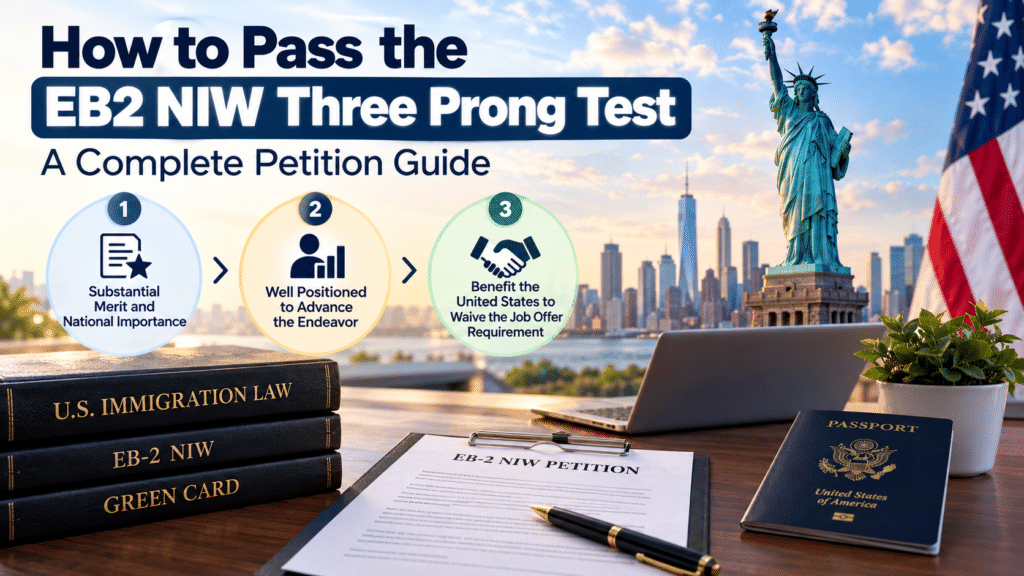
How to Pass the EB2 NIW Three Prong Test: A Complete Petition Guide For many professionals, researchers, engineers, healthcare specialists, and entrepreneurs, obtaining a U.S. green card is an important career goal. The EB-2 National Interest Waiver (NIW) offers a potential route to permanent residence without the usual requirement for an employer-sponsored job offer or labor certification. However, having an advanced degree, years of experience, or an impressive professional background does not automatically lead to approval. Applicants must explain what they intend to accomplish in the United States, why their work matters, and why granting a waiver would benefit the country. Understanding the eb2 niw three prong test is essential before preparing a petition. This eb2 niw petition guide explains the three legal requirements, the evidence applicants can use, and common mistakes that may weaken an otherwise promising case. If you are researching how to pass the eb2 niw three prong test, the most important starting point is to build a clear, evidence-based case that connects your professional achievements with a meaningful future endeavor. Understanding the EB2 NIW Three Prong Test The three-prong framework comes from Matter of Dhanasar, 26 I&N Dec. 884 (AAO 2016). USCIS evaluates whether: The proposed endeavor has substantial merit and national importance. The applicant is well positioned to advance the proposed endeavor. On balance, it would benefit the United States to waive the job offer and labor certification requirements. Applicants must also establish eligibility for the underlying EB-2 classification, generally through an advanced degree or exceptional ability. Meeting the three NIW requirements does not replace this initial eligibility requirement. USCIS assesses petitions individually, considering the evidence presented and the applicable legal standards. No single document guarantees approval. Prong 1: Demonstrate Substantial Merit and National Importance The first prong focuses on the applicant’s proposed endeavor. It is not enough to say that you want to continue working in technology, healthcare, business, or another important industry. You must describe the specific work you plan to undertake and explain its potential broader impact. For example, an artificial intelligence engineer might propose developing cybersecurity tools that help small businesses identify and respond to digital threats. A healthcare researcher might plan to develop more accessible methods of early disease detection. Both endeavors may have substantial merit. However, the petition must explain why the particular work has potential national importance rather than relying solely on the importance of the industry. Evidence that can strengthen Prong 1 Consider providing: A detailed description of your proposed endeavor and its objectives. Government reports and credible industry research identifying the problem you intend to address. A business plan or research proposal with realistic milestones. Evidence of potential economic, technological, scientific, or public-health benefits. Letters of interest from organizations, prospective partners, or relevant stakeholders. Supporting publications or research demonstrating the need for your proposed work. The key is specificity. Instead of claiming that your work will transform an entire industry, explain the problem, your proposed solution, the people or organizations who may benefit, and the evidence supporting your expected impact. Prong 2: Show That You Are Well Positioned to Advance Your Endeavor The second prong examines your ability to move the proposed endeavor forward. A promising idea alone may not be sufficient; your qualifications, previous achievements, preparation, and available resources should support a credible plan. Imagine a data scientist proposing predictive analytics tools for healthcare providers. Relevant evidence might include previous successful projects, technical publications, documented improvements in model performance, and professional relationships with healthcare organizations. The petition should make the connection between these achievements and the proposed future work clear. What evidence should you prepare? Depending on your background, useful evidence may include: Academic degrees, professional certifications, and relevant training. Publications, patents, citations, or documented original contributions. Records of successful projects and leadership responsibilities. Recommendation letters from experts who can explain your specific achievements. Contracts, funding evidence, partnership discussions, or expressions of customer interest. A credible implementation plan showing how you intend to proceed. Recommendation letters are more persuasive when they explain concrete accomplishments and the writer’s basis for evaluating your work. General praise without supporting details may carry less weight. You do not necessarily need every type of evidence listed above. Select documents that genuinely demonstrate your preparation and ability to advance the proposed endeavor. Prong 3: Explain Why Waiving the Job Offer Requirement Benefits the United States The third prong asks why the United States would benefit, on balance, from waiving the usual job offer and labor certification requirements. Applicants sometimes assume that demonstrating the importance of their work is enough. However, the third prong requires a separate explanation of why the waiver is justified in their particular circumstances. For example, an entrepreneur may plan to develop a business that introduces useful technology, addresses a market need, or creates employment opportunities. A petition could explain the business model, the applicant’s role, and the potential benefits supported by credible projections and other evidence. A researcher may explain how their proposed work could continue across projects or collaborations and why their particular contributions would benefit the United States even if qualified U.S. workers are available. How can you support Prong 3? Depending on your case, consider explaining: Why the nature of your endeavor or qualifications may make the traditional job offer and labor certification process impractical. Why the United States could benefit from your contributions even assuming qualified U.S. workers are available. Whether your work could produce meaningful economic, scientific, technological, or societal benefits. Whether the nature or urgency of your proposed contributions supports granting the waiver. These are possible arguments, not separate mandatory requirements that every applicant must satisfy individually. The petition should explain why the overall circumstances support granting the waiver. Common Mistakes That Can Weaken an EB-2 NIW Petition Even qualified professionals can weaken their petitions through avoidable errors. Describing the endeavor too broadly. Saying you intend to work as an engineer or business consultant does not adequately explain your specific plans or their potential impact. Relying only on qualifications. Degrees

Blog

EB-5 vs. E-2 Visa: Choosing the Right U.S. Investment Immigration Option

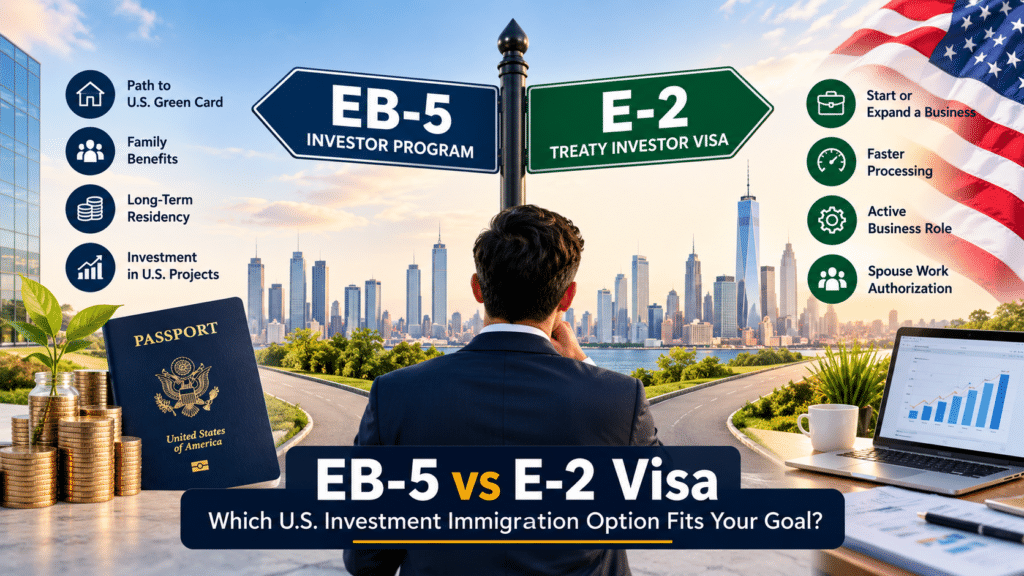
EB-5 vs. E-2 Visa: Choosing the Right U.S. Investment Immigration Option For many foreign investors and entrepreneurs, moving to the United States is not simply a matter of obtaining a visa. The bigger question is what kind of future they want to build in the country. Some investors want a Green Card and are prepared to commit significant capital for that long-term objective. Others want to start or expand a business in the United States as quickly as possible and would rather maintain greater control over their investment. This is why the decision between different investment and business immigration options can be complicated. The EB-5 Immigrant Investor Program and the E-2 Treaty Investor visa are often discussed together, but they serve very different purposes. There are also other US investment visa alternatives, including the L-1A and, in appropriate circumstances, the EB-1C immigrant classification. Understanding these differences before committing money to a U.S. business or investment project can make a significant difference to an investor’s long-term immigration strategy. Understanding the EB-5 Investor Program The EB-5 program is particularly attractive to investors whose primary objective is U.S. permanent residence. Unlike a temporary business visa, EB-5 is an immigrant classification that can lead to lawful permanent resident status for the qualifying investor and eligible family members. Under the current rules, the minimum qualifying investment is generally $800,000 when the investment meets the requirements for a targeted employment area or certain qualifying infrastructure projects. For investments outside those categories, the minimum is generally $1,050,000. The investment must also satisfy the program’s job-creation requirements. USCIS requires the investment to create at least 10 qualifying full-time jobs. An investor may pursue EB-5 through a direct investment or through a regional center-associated project. A direct investment can involve a business that the investor is personally developing or operating. Regional center investments can provide a more passive structure, although investors still need to understand the specific project, financial risks, offering documents, and immigration requirements before investing. One important point is that EB-5 is not simply a matter of transferring $800,000 or $1.05 million to a U.S. account. The source and path of the investment funds, the structure of the investment, the job-creation evidence, and the continuing requirements of the program all matter. USCIS also expects appropriate evidence showing that the required jobs will be created; where jobs have not yet been created, a credible and sufficiently detailed business plan can be important evidence. For someone whose main objective is permanent residency rather than running a business personally, EB-5 can therefore be an attractive option. Where the E-2 Visa Is Different The E-2 Treaty Investor visa takes a different approach. It is designed for eligible nationals of treaty countries who make a substantial investment in a U.S. business and actively develop and direct that enterprise. One of the major attractions of E-2 is that U.S. immigration law does not establish one universal minimum dollar amount that every E-2 applicant must invest. Instead, the investment must be substantial in relation to the cost of purchasing or establishing the particular business, and the overall business and investment must satisfy the applicable E-2 requirements. This makes E-2 potentially appealing to entrepreneurs who want to establish a company, purchase a franchise, or acquire an operating business without committing the amount of capital normally associated with EB-5. However, nationality is an important consideration. E-2 is available only to nationals of countries that have the required treaty relationship with the United States. Therefore, an investor should check treaty eligibility before spending money on an E-2 business strategy. Another important difference is the investor’s role. E-2 is generally not intended to be a passive investment. The investor must be coming to the United States to develop and direct the enterprise. In practical terms, this makes E-2 more suitable for an entrepreneur who wants to be involved in the business rather than simply invest capital and step away. How to Choose Between EB-5 and E-2 Visa for US Residency For investors researching how to choose between EB-5 and E-2 visa for US residency, the first question should not be, “Which visa is easier?” A better question is, “What do I actually want my U.S. immigration status to accomplish?” If permanent residence is the main objective, EB-5 deserves serious consideration. It is specifically an immigrant pathway and can ultimately provide permanent resident status when all applicable requirements are satisfied. E-2 is different. It is a nonimmigrant classification. It can provide a practical way for an eligible entrepreneur to live in the United States while operating a qualifying business, and it can be extended as long as the applicant continues to meet the requirements. However, E-2 by itself is not a direct Green Card category. The second question is whether the investor qualifies based on nationality. A person may have sufficient money and a strong business plan but still be unable to pursue E-2 directly if they do not have the nationality of an eligible treaty country. The third question is how involved the investor wants to be in the business. Someone who wants to run a company, manage employees, develop customers and make operational decisions may find E-2 attractive. Someone who prefers a more passive investment structure may find a qualifying EB-5 regional center investment more suitable. Finally, investors should consider liquidity. EB-5 involves a significant capital commitment and specific immigration requirements surrounding the investment. E-2 also requires genuine investment in a business, but the structure and purpose are different. Neither should be treated simply as a way of “parking” money in the United States. Looking at Other US Investment Visa Alternatives The EB-5 vs E-2 visa discussion should not be the end of the analysis. Some business owners have another option because they already operate a company outside the United States. For example, the L-1A classification may be relevant to certain executives and managers of qualifying foreign companies who are being transferred to an affiliated U.S. entity. This can be particularly interesting for established international businesses

Blog

EB-5 Visa Process Step by Step: From Investment to Permanent Green Card

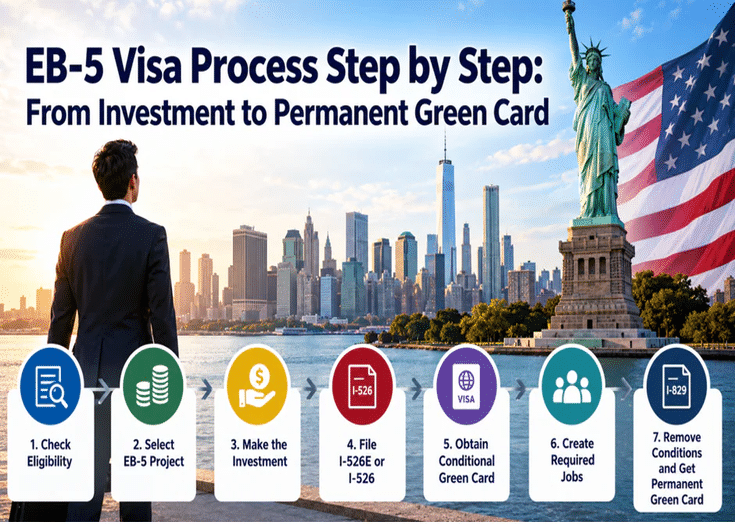
EB-5 Visa Process Step by Step: From Investment to Permanent Green Card The EB-5 Immigrant Investor Program offers a pathway to U.S. permanent residence for eligible foreign investors who make a qualifying investment in a U.S. commercial enterprise and satisfy the required job-creation rules. However, the process involves much more than simply transferring money into a U.S. project. For investors considering this immigration route, understanding the EB-5 visa process step by step from investment to green card can make the overall journey easier to understand and plan. Step 1: Determine EB-5 Eligibility The first stage is determining whether the investor meets the basic EB-5 requirements. Under the current EB-5 framework, the required investment is generally $1.05 million, or $800,000 when the investment qualifies for the reduced amount applicable to certain targeted employment areas or qualifying infrastructure projects. The investment must be made in a qualifying new commercial enterprise, and the required capital must be placed at risk for the purpose of generating a return. The investor must also demonstrate that the capital came from a lawful source. Source-of-funds documentation is therefore an important part of the case. Depending on the investor’s circumstances, evidence may include tax records, salary records, business documents, property-sale records, bank statements, loan documents, inheritance records, or other financial records. Step 2: Select an EB-5 Investment Project Once eligibility is established, the investor needs to identify a suitable EB-5 project. Many investors participate through a USCIS-designated regional center. Regional center projects can provide a structured investment opportunity and may allow qualifying indirect job creation to satisfy the employment requirement. Investors should carefully review the project’s business plan, financial structure, expected job creation, investment documents, exit strategy, and associated risks before committing capital. The immigration requirements and the financial merits of an investment are separate considerations. Approval of an EB-5 petition does not guarantee that an investor will receive a financial return. Step 3: Make the Investment and Document the Source of Funds The investor then transfers or commits the required capital according to the investment structure. USCIS requires evidence showing where the investment funds came from and how they moved from their original source into the EB-5 investment. Maintaining a clear financial trail is particularly important. For example, if funds originated from the sale of property, the investor may need to document ownership of the property, the sale transaction, receipt of the proceeds, and subsequent transfer of those funds. Step 4: File Form I-526E or Form I-526 The next major stage is filing the appropriate immigrant petition with USCIS. Investors participating in a regional center project generally file Form I-526E, Immigrant Petition by Regional Center Investor. Standalone investors generally use Form I-526, Immigrant Petition by Standalone Investor. The petition package normally includes evidence concerning the investment, lawful source and path of funds, qualifying commercial enterprise, business plan, and job-creation requirements. USCIS currently distinguishes between I-526E regional center petitions and I-526 standalone petitions. Processing times can vary considerably, so investors should check current USCIS processing information rather than relying on historical estimates. Step 5: Apply for Conditional Permanent Residence After USCIS approves the EB-5 petition, the investor proceeds toward obtaining conditional permanent resident status, assuming an immigrant visa is available and the investor otherwise qualifies. Applicants outside the United States generally proceed through immigrant visa processing with the Department of State. Eligible applicants already in the United States may be able to file for adjustment of status through Form I-485, depending on their circumstances and visa availability. Once approved, the investor receives conditional permanent resident status for two years. Step 6: Maintain the Investment and Meet the Job Requirement During the conditional residence period, the investment must continue to satisfy the applicable EB-5 requirements. A central requirement is the creation of at least 10 qualifying full-time jobs for eligible U.S. workers. For regional center investments, qualifying job creation can include indirect jobs under the applicable rules. Investors should retain financial and project records throughout this period because documentation may later be required when seeking removal of the conditions. Step 7: File Form I-829 to Remove Conditions The final major stage of the EB-5 green card process is filing Form I-829, Petition by Investor to Remove Conditions on Permanent Resident Status. The petition is generally filed during the 90-day period immediately before the second anniversary of the investor becoming a conditional permanent resident. The investor must provide evidence demonstrating that the required capital was invested and sustained as required and that the required employment was created, or is expected to be created within the applicable period. USCIS identifies evidence such as financial records, payroll records, tax documents, and other business documentation as potentially relevant to demonstrating compliance. From EB-5 Investment to a Permanent Green Card The EB-5 visa process is therefore a multi-stage immigration journey: eligibility assessment, project selection, investment and source-of-funds documentation, I-526E or I-526 filing, conditional permanent residence, maintenance of the investment and job creation, and finally the I-829 petition. Because every investor’s financial history, investment structure, immigration circumstances, and documentation are different, careful preparation is important from the beginning. Investors considering EB-5 should review the current USCIS requirements and obtain qualified professional guidance before making a substantial investment or filing an immigration petition.

Blog

Behind Every Successful U.S. Employment-Based Immigration Petition: The Power of Strategic Case Preparation

Behind Every Successful U.S. Employment-Based Immigration Petition: The Power of Strategic Case Preparation For many highly skilled professionals, entrepreneurs, researchers, executives, physicians, engineers, and innovators, obtaining a U.S. employment-based immigration benefit represents years of dedication and professional achievement. However, the success of an immigration petition is determined not only by an applicant’s accomplishments but also by how effectively those accomplishments are documented and presented. Every immigration case tells a unique professional story. The challenge is transforming years of education, work experience, research, leadership, innovation, and industry recognition into a well-supported petition that satisfies the applicable legal standards established by U.S. immigration law. Every Professional Achievement Should Be Supported by Evidence Employment-based immigration petitions rely heavily on documentary evidence. USCIS evaluates the quality, credibility, and relevance of the evidence submitted rather than simply accepting statements made by the applicant. A comprehensive case file may include: Academic degrees and educational credentials Professional licenses and certifications Employment verification letters Performance evaluations Awards and honors Professional memberships Conference presentations Published articles Citation records Media coverage Patents or intellectual property Business achievements Leadership documentation Recommendation letters Contracts and consulting engagements Each document should contribute to demonstrating the applicant’s professional accomplishments in a clear and organized manner. Organizing Evidence Is as Important as Collecting It Submitting hundreds of pages of documents without proper organization can make it difficult for an adjudicating officer to understand the significance of the evidence. A well-prepared petition generally includes: A detailed exhibit index Clearly labeled supporting documents Logical sequencing of evidence Cross-references throughout the filing Concise summaries explaining key accomplishments Consistent formatting across all exhibits This structured approach allows the reviewing officer to efficiently locate and evaluate supporting documentation. Demonstrating Professional Impact Many employment-based immigration categories require applicants to demonstrate that their work has had a meaningful impact within their profession. Examples of evidence that may help establish professional impact include: Development of innovative technologies Leadership of significant projects Contributions that improved organizational performance Industry awards and recognition Invitations to judge the work of others Publications in reputable journals or industry media Speaking engagements at professional conferences Independent expert testimonials Evidence of national or international recognition Whenever possible, objective documentation should support these accomplishments with measurable results. The Importance of a Consistent Professional Narrative A successful petition should present a consistent story across every document submitted. The applicant’s resume, recommendation letters, employment history, publications, and supporting exhibits should complement one another rather than create inconsistencies. Reviewing every document for accuracy helps ensure that: Employment dates are consistent. Job titles match supporting records. Publications are properly documented. Awards are accurately described. Professional achievements are supported by evidence. Consistency enhances the credibility of the overall petition. Preparing Strong Recommendation Letters Recommendation letters provide valuable insight into an applicant’s professional reputation and the significance of their work. Well-prepared letters often explain: The expert’s relationship with the applicant The applicant’s technical or professional expertise Specific accomplishments Industry contributions Leadership qualities Original work Broader impact within the profession Specific examples supported by objective evidence are generally more persuasive than broad statements of praise. Anticipating Questions Before Filing One hallmark of careful case preparation is identifying potential issues before a petition is submitted. This may involve reviewing: Employment gaps Publication history Authorship evidence Award documentation Organizational reputation Media credibility Research significance Evidence supporting leadership roles Addressing these issues proactively can help produce a more complete filing. Collaboration Throughout the Process Preparing an employment-based immigration petition often involves coordination among applicants, employers (where applicable), professional references, translators, credential evaluators, and legal professionals. Timely communication and careful document review contribute to an efficient preparation process while helping ensure that required documentation is complete before filing. Final Thoughts A successful U.S. employment-based immigration petition is built upon careful planning, detailed documentation, and thoughtful presentation of the applicant’s professional accomplishments. Every piece of evidence should support a clear and credible narrative demonstrating the applicant’s qualifications under the applicable immigration category. Because every case presents unique facts and legal considerations, thorough preparation is essential. Organizing evidence, maintaining consistency, and ensuring that supporting documentation accurately reflects the applicant’s achievements can significantly strengthen the overall petition. Disclosure: Immigration legal advice, legal strategy, eligibility assessments, legal representation before U.S. immigration authorities, and the preparation and filing of immigration petitions are performed by licensed U.S. immigration attorneys, as applicable. Administrative support, document organization, factual compilation, case coordination, and other non-legal services should always be provided in accordance with applicable laws and ethical requirements.

Blog

The Foundation of a Strong Employment-Based U.S. Immigration Petition: Why Evidence Matters More Than Eligibility

The Foundation of a Strong Employment-Based U.S. Immigration Petition: Why Evidence Matters More Than Eligibility When pursuing an employment-based U.S. immigration benefit, many applicants focus solely on whether they meet the eligibility criteria. However, experienced practitioners understand that eligibility alone is rarely enough. The strength of a petition depends on how effectively the evidence is organized, analyzed, and presented to support every legal requirement. Whether preparing a petition under the EB-1A Extraordinary Ability category, O-1A Extraordinary Ability classification, or EB-2 National Interest Waiver (NIW), every successful case begins with a detailed review of the applicant’s professional achievements, supporting documentation, and applicable legal standards. Comprehensive Case Evaluation A well-prepared immigration matter starts with a thorough assessment of the applicant’s qualifications. This typically includes reviewing: Each piece of evidence should be evaluated not only for relevance but also for credibility, consistency, and legal significance. Educational credentials Employment history Professional accomplishments Publications and scholarly contributions Awards and recognitions Memberships in professional associations Judging or peer review experience Original contributions of major significance Media coverage Leadership or critical roles Salary documentation Recommendation letters Future plans in the United States  Each piece of evidence should be evaluated not only for relevance but also for credibility, consistency, and legal significance. Building a Strong Evidentiary Record One of the most important aspects of preparing an employment-based petition is developing an organized evidentiary record. Supporting documentation should clearly establish how the applicant satisfies the applicable regulatory requirements. This often involves: Reviewing documentary evidence for completeness. Identifying gaps requiring additional documentation. Organizing exhibits in a logical sequence. Preparing detailed exhibit indexes. Cross-referencing evidence throughout the legal submission. Ensuring consistency across forms, declarations, and supporting documents. An organized evidentiary record helps adjudicating officers efficiently understand the applicant’s qualifications. Drafting Legal Support Documents Many employment-based immigration cases require extensive legal documentation, including: Personal statements Professional accomplishment summaries Detailed curriculum vitae reviews Recommendation letter drafts Employer support letters (when applicable) Business plans (for selected National Interest Waiver cases) Proposed endeavor statements Exhibit lists Documentary summaries These materials should accurately reflect the applicant’s achievements while remaining fully supported by documentary evidence. Importance of Recommendation Letters Recommendation letters often play a significant role in explaining an applicant’s professional impact. Strong letters generally: Describe the applicant’s expertise. Explain the significance of their work. Discuss measurable accomplishments. Highlight industry recognition. Demonstrate national or international impact. Provide independent expert opinions supported by facts. The most persuasive letters are specific, evidence-based, and tailored to the facts of the individual case. Preparing for Requests for Evidence (RFEs) Even well-prepared petitions may receive a Request for Evidence (RFE). A carefully developed initial filing can significantly reduce potential issues and make responding to an RFE more straightforward. Effective preparation includes: Identifying potential weaknesses before filing. Addressing complex eligibility issues proactively. Providing objective documentary support. Explaining legal standards clearly. Organizing evidence for easy review. Comprehensive preparation at the initial filing stage often contributes to a more efficient adjudication process. Accuracy and Consistency Are Essential Immigration petitions frequently involve numerous documents, including forms, letters, resumes, publications, certificates, employment records, and supporting exhibits. Every document should be reviewed to ensure: Consistency of dates. Accurate employment history. Matching educational information. Consistent job titles. Correct organizational names. Accurate citations to supporting exhibits. Small inconsistencies may create unnecessary questions during adjudication. Conclusion Preparing a successful employment-based immigration petition requires more than collecting documents. It requires careful analysis, strategic organization of evidence, and a clear presentation of the facts in accordance with applicable immigration laws and regulations. Every applicant’s professional background is unique. A comprehensive review of qualifications and supporting evidence helps identify the strongest aspects of the case and ensures that the petition is presented in a clear, organized, and persuasive manner. Disclosure: Immigration legal advice, legal strategy, representation before U.S. immigration agencies, and the preparation and filing of immigration petitions are performed by or under the supervision of licensed U.S. immigration attorneys, as applicable. Supporting case preparation, document organization, factual compilation, administrative assistance, and client coordination should be conducted in compliance with applicable laws and professional responsibility requirements.