
EB-5 vs. E-2 Visa: Choosing the Right U.S. Investment Immigration Option
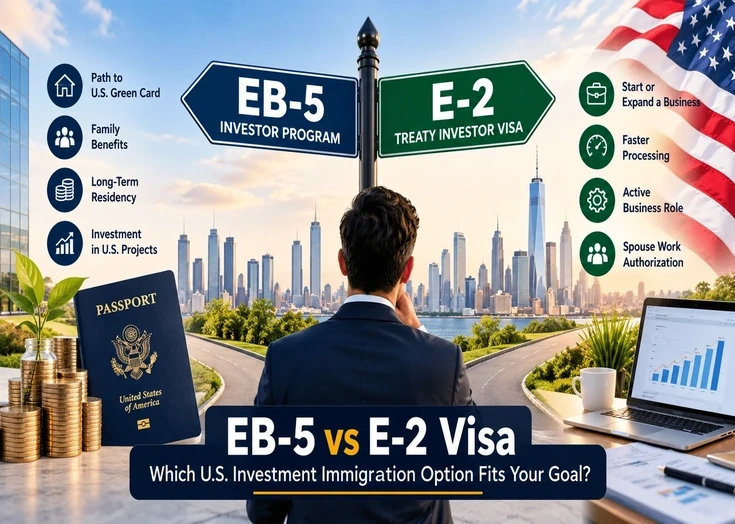
For many foreign investors and entrepreneurs, moving to the United States is not simply a matter of obtaining a visa. The bigger question is what kind of future they want to build in the country. Some investors want a Green Card and are prepared to commit significant capital for that long-term objective. Others want to start or expand a business in the United States as quickly as possible and would rather maintain greater control over their investment.
This is why the decision between different investment and business immigration options can be complicated. The EB-5 Immigrant Investor Program and the E-2 Treaty Investor visa are often discussed together, but they serve very different purposes. There are also other US investment visa alternatives, including the L-1A and, in appropriate circumstances, the EB-1C immigrant classification.
Understanding these differences before committing money to a U.S. business or investment project can make a significant difference to an investor’s long-term immigration strategy.
Understanding the EB-5 Investor Program
The EB-5 program is particularly attractive to investors whose primary objective is U.S. permanent residence. Unlike a temporary business visa, EB-5 is an immigrant classification that can lead to lawful permanent resident status for the qualifying investor and eligible family members.
Under the current rules, the minimum qualifying investment is generally $800,000 when the investment meets the requirements for a targeted employment area or certain qualifying infrastructure projects. For investments outside those categories, the minimum is generally $1,050,000. The investment must also satisfy the program’s job-creation requirements. USCIS requires the investment to create at least 10 qualifying full-time jobs.
An investor may pursue EB-5 through a direct investment or through a regional center-associated project. A direct investment can involve a business that the investor is personally developing or operating. Regional center investments can provide a more passive structure, although investors still need to understand the specific project, financial risks, offering documents, and immigration requirements before investing.
One important point is that EB-5 is not simply a matter of transferring $800,000 or $1.05 million to a U.S. account. The source and path of the investment funds, the structure of the investment, the job-creation evidence, and the continuing requirements of the program all matter. USCIS also expects appropriate evidence showing that the required jobs will be created; where jobs have not yet been created, a credible and sufficiently detailed business plan can be important evidence.
For someone whose main objective is permanent residency rather than running a business personally, EB-5 can therefore be an attractive option.
Where the E-2 Visa Is Different
The E-2 Treaty Investor visa takes a different approach. It is designed for eligible nationals of treaty countries who make a substantial investment in a U.S. business and actively develop and direct that enterprise.
One of the major attractions of E-2 is that U.S. immigration law does not establish one universal minimum dollar amount that every E-2 applicant must invest. Instead, the investment must be substantial in relation to the cost of purchasing or establishing the particular business, and the overall business and investment must satisfy the applicable E-2 requirements.
This makes E-2 potentially appealing to entrepreneurs who want to establish a company, purchase a franchise, or acquire an operating business without committing the amount of capital normally associated with EB-5.
However, nationality is an important consideration. E-2 is available only to nationals of countries that have the required treaty relationship with the United States. Therefore, an investor should check treaty eligibility before spending money on an E-2 business strategy.
Another important difference is the investor’s role. E-2 is generally not intended to be a passive investment. The investor must be coming to the United States to develop and direct the enterprise. In practical terms, this makes E-2 more suitable for an entrepreneur who wants to be involved in the business rather than simply invest capital and step away.
How to Choose Between EB-5 and E-2 Visa for US Residency
For investors researching how to choose between EB-5 and E-2 visa for US residency, the first question should not be, “Which visa is easier?” A better question is, “What do I actually want my U.S. immigration status to accomplish?”
If permanent residence is the main objective, EB-5 deserves serious consideration. It is specifically an immigrant pathway and can ultimately provide permanent resident status when all applicable requirements are satisfied.
E-2 is different. It is a nonimmigrant classification. It can provide a practical way for an eligible entrepreneur to live in the United States while operating a qualifying business, and it can be extended as long as the applicant continues to meet the requirements. However, E-2 by itself is not a direct Green Card category.
The second question is whether the investor qualifies based on nationality. A person may have sufficient money and a strong business plan but still be unable to pursue E-2 directly if they do not have the nationality of an eligible treaty country.
The third question is how involved the investor wants to be in the business. Someone who wants to run a company, manage employees, develop customers and make operational decisions may find E-2 attractive. Someone who prefers a more passive investment structure may find a qualifying EB-5 regional center investment more suitable.
Finally, investors should consider liquidity. EB-5 involves a significant capital commitment and specific immigration requirements surrounding the investment. E-2 also requires genuine investment in a business, but the structure and purpose are different. Neither should be treated simply as a way of “parking” money in the United States.
Looking at Other US Investment Visa Alternatives
The EB-5 vs E-2 visa discussion should not be the end of the analysis. Some business owners have another option because they already operate a company outside the United States.
For example, the L-1A classification may be relevant to certain executives and managers of qualifying foreign companies who are being transferred to an affiliated U.S. entity. This can be particularly interesting for established international businesses that are planning a U.S. expansion.
In the right circumstances, an L-1A strategy can also form part of a longer-term plan toward an EB-1C multinational manager or executive immigrant petition. The requirements are detailed, and the corporate relationship, qualifying employment history, U.S. business structure, and operational requirements all need to be carefully evaluated.
This means that an investor should not automatically assume that an investment visa is the only solution. Existing businesses, professional experience, corporate relationships, nationality and long-term immigration objectives can all change the appropriate strategy.
Which Option May Make More Sense?
Consider a hypothetical investor with substantial capital who wants a U.S. Green Card and does not want to manage a business every day. EB-5 may deserve closer examination because its central objective is permanent immigration through qualifying investment.
Now consider an entrepreneur who wants to purchase a U.S. franchise, actively manage it, and move to the United States relatively quickly. If that person has an eligible treaty nationality, E-2 could potentially be a more natural fit.
A third person may already own a successful company abroad and want to establish a U.S. subsidiary. For that individual, L-1A and potentially a later EB-1C strategy could be more relevant than either EB-5 or E-2.
There is therefore no universal “best” investment visa. The right option depends on the investor’s nationality, available capital, business experience, desired level of involvement, family objectives and long-term immigration plans.
Final Thoughts
The biggest mistake an investor can make is choosing an immigration category solely because another investor had success with it. Immigration strategy should be built around the person’s own circumstances.
EB-5 can be attractive for investors focused on permanent residence and willing to make the required qualifying investment. E-2 can be useful for eligible treaty-country entrepreneurs who want to actively operate a U.S. business. L-1A and EB-1C may provide another route for qualifying owners and executives with an established international business.
Before transferring substantial funds, purchasing a business, or signing an investment agreement, it is worth reviewing both the immigration requirements and the underlying financial structure. A decision that looks attractive from an investment perspective may not necessarily produce the desired immigration result.
For investors comparing US investment visa alternatives the most useful approach is to start with the end goal: temporary business expansion, U.S. entrepreneurship, or permanent residence. Once that objective is clear, the appropriate immigration pathway becomes much easier to evaluate.
Disclaimer:
This article is provided for general informational purposes only and does not constitute legal or immigration advice. Eligibility and petition outcomes depend on individual facts and current USCIS requirements.
