
How to Pass the EB2 NIW Three Prong Test: A Complete Petition Guide
For many professionals, researchers, engineers, healthcare specialists, and entrepreneurs, obtaining a U.S. green card is an important career goal. The EB-2 National Interest Waiver (NIW) offers a potential route to permanent residence without the usual requirement for an employer-sponsored job offer or labor certification.
However, having an advanced degree, years of experience, or an impressive professional background does not automatically lead to approval. Applicants must explain what they intend to accomplish in the United States, why their work matters, and why granting a waiver would benefit the country.
Understanding the eb2 niw three prong test is essential before preparing a petition. This eb2 niw petition guide explains the three legal requirements, the evidence applicants can use, and common mistakes that may weaken an otherwise promising case.
If you are researching how to pass the eb2 niw three prong test, the most important starting point is to build a clear, evidence-based case that connects your professional achievements with a meaningful future endeavor.
Understanding the EB2 NIW Three Prong Test
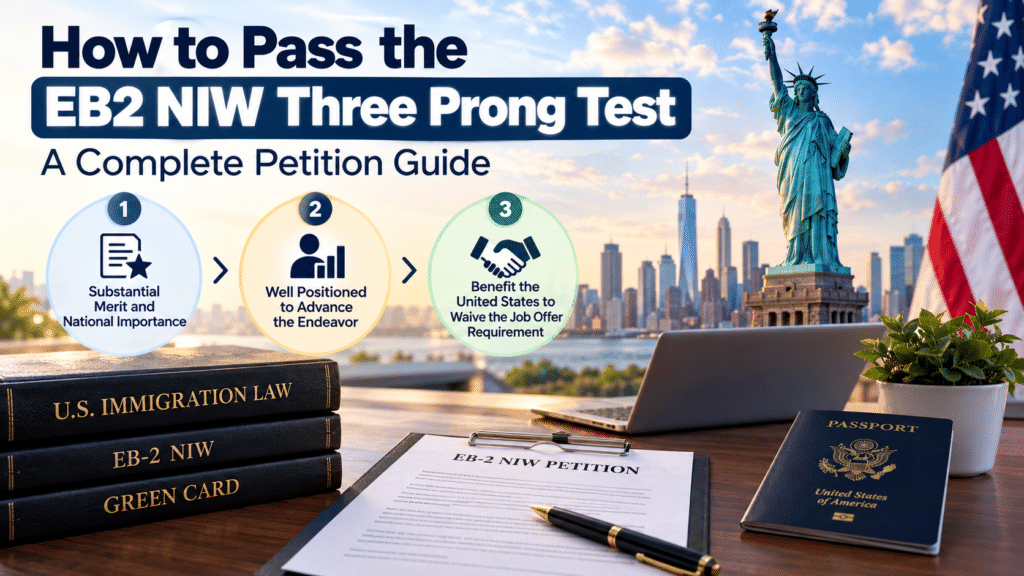
The three-prong framework comes from Matter of Dhanasar, 26 I&N Dec. 884 (AAO 2016). USCIS evaluates whether:
- The proposed endeavor has substantial merit and national importance.
- The applicant is well positioned to advance the proposed endeavor.
- On balance, it would benefit the United States to waive the job offer and labor certification requirements.
Applicants must also establish eligibility for the underlying EB-2 classification, generally through an advanced degree or exceptional ability. Meeting the three NIW requirements does not replace this initial eligibility requirement.
USCIS assesses petitions individually, considering the evidence presented and the applicable legal standards. No single document guarantees approval.
Prong 1: Demonstrate Substantial Merit and National Importance
The first prong focuses on the applicant’s proposed endeavor. It is not enough to say that you want to continue working in technology, healthcare, business, or another important industry. You must describe the specific work you plan to undertake and explain its potential broader impact.
For example, an artificial intelligence engineer might propose developing cybersecurity tools that help small businesses identify and respond to digital threats. A healthcare researcher might plan to develop more accessible methods of early disease detection.
Both endeavors may have substantial merit. However, the petition must explain why the particular work has potential national importance rather than relying solely on the importance of the industry.
Evidence that can strengthen Prong 1
Consider providing:
- A detailed description of your proposed endeavor and its objectives.
- Government reports and credible industry research identifying the problem you intend to address.
- A business plan or research proposal with realistic milestones.
- Evidence of potential economic, technological, scientific, or public-health benefits.
- Letters of interest from organizations, prospective partners, or relevant stakeholders.
- Supporting publications or research demonstrating the need for your proposed work.
The key is specificity. Instead of claiming that your work will transform an entire industry, explain the problem, your proposed solution, the people or organizations who may benefit, and the evidence supporting your expected impact.
Prong 2: Show That You Are Well Positioned to Advance Your Endeavor
The second prong examines your ability to move the proposed endeavor forward. A promising idea alone may not be sufficient; your qualifications, previous achievements, preparation, and available resources should support a credible plan.
Imagine a data scientist proposing predictive analytics tools for healthcare providers. Relevant evidence might include previous successful projects, technical publications, documented improvements in model performance, and professional relationships with healthcare organizations.
The petition should make the connection between these achievements and the proposed future work clear.
What evidence should you prepare?
Depending on your background, useful evidence may include:
- Academic degrees, professional certifications, and relevant training.
- Publications, patents, citations, or documented original contributions.
- Records of successful projects and leadership responsibilities.
- Recommendation letters from experts who can explain your specific achievements.
- Contracts, funding evidence, partnership discussions, or expressions of customer interest.
- A credible implementation plan showing how you intend to proceed.
Recommendation letters are more persuasive when they explain concrete accomplishments and the writer’s basis for evaluating your work. General praise without supporting details may carry less weight.
You do not necessarily need every type of evidence listed above. Select documents that genuinely demonstrate your preparation and ability to advance the proposed endeavor.
Prong 3: Explain Why Waiving the Job Offer Requirement Benefits the United States
The third prong asks why the United States would benefit, on balance, from waiving the usual job offer and labor certification requirements.
Applicants sometimes assume that demonstrating the importance of their work is enough. However, the third prong requires a separate explanation of why the waiver is justified in their particular circumstances.
For example, an entrepreneur may plan to develop a business that introduces useful technology, addresses a market need, or creates employment opportunities. A petition could explain the business model, the applicant’s role, and the potential benefits supported by credible projections and other evidence.
A researcher may explain how their proposed work could continue across projects or collaborations and why their particular contributions would benefit the United States even if qualified U.S. workers are available.
How can you support Prong 3?
Depending on your case, consider explaining:
- Why the nature of your endeavor or qualifications may make the traditional job offer and labor certification process impractical.
- Why the United States could benefit from your contributions even assuming qualified U.S. workers are available.
- Whether your work could produce meaningful economic, scientific, technological, or societal benefits.
- Whether the nature or urgency of your proposed contributions supports granting the waiver.
These are possible arguments, not separate mandatory requirements that every applicant must satisfy individually. The petition should explain why the overall circumstances support granting the waiver.
Common Mistakes That Can Weaken an EB-2 NIW Petition
Even qualified professionals can weaken their petitions through avoidable errors.
- Describing the endeavor too broadly. Saying you intend to work as an engineer or business consultant does not adequately explain your specific plans or their potential impact.
- Relying only on qualifications. Degrees and professional experience may support EB-2 eligibility and the second prong, but they do not automatically establish all three NIW requirements.
- Making unsupported claims. Predictions about job creation, business growth, research influence, or national benefits should be realistic and supported wherever possible.
- Submitting generic recommendation letters. Letters should provide specific examples of your contributions and explain their relevance to the proposed endeavor.
- Overlooking the third prong. A petition must explain why granting the waiver would benefit the United States, not simply why the applicant is qualified.
- Using outdated information. Review the current USCIS Policy Manual and applicable filing instructions before submitting your petition. USCIS published updated NIW guidance on January 15, 2025, addressing the three-prong analysis and evidence relevant to areas including STEM and entrepreneurship.
Build a Consistent Petition From Start to Finish
A strong petition tells one coherent story. Your proposed endeavor, personal statement, business plan, recommendation letters, and supporting exhibits should reinforce one another.
A practical approach is to create an evidence checklist with four columns: the legal requirement, your argument, the supporting documents, and any evidence gaps that remain.
Review each prong separately, then examine the petition as a whole. Ask whether an officer unfamiliar with your career could understand what you intend to accomplish, why your work matters, why you are prepared to pursue it, and why the waiver is justified.
This preparation can also help identify weaknesses before filing, when there may still be time to obtain additional documentation or clarify the proposed endeavor.
Conclusion:
Knowing how to pass the eb2 niw three prong test begins with understanding that approval depends on more than a strong résumé or an impressive collection of documents. Applicants must present a specific proposed endeavor, demonstrate their ability to advance it, and explain why granting a waiver would benefit the United States.
This eb2 niw petition guide provides a framework for organizing your case, but every application requires an individualized assessment of the applicant’s qualifications, plans, and supporting evidence.
Before filing, review the current USCIS guidance, ensure that your documents are consistent, and address all three prongs with clear, credible evidence. Careful preparation can make your petition more persuasive, although no strategy can guarantee approval.
Disclaimer:
This article is for general educational purposes only. It does not constitute legal advice or guarantee an immigration outcome.
