
EB-5 Visa Process Step by Step: From Investment to Permanent Green Card
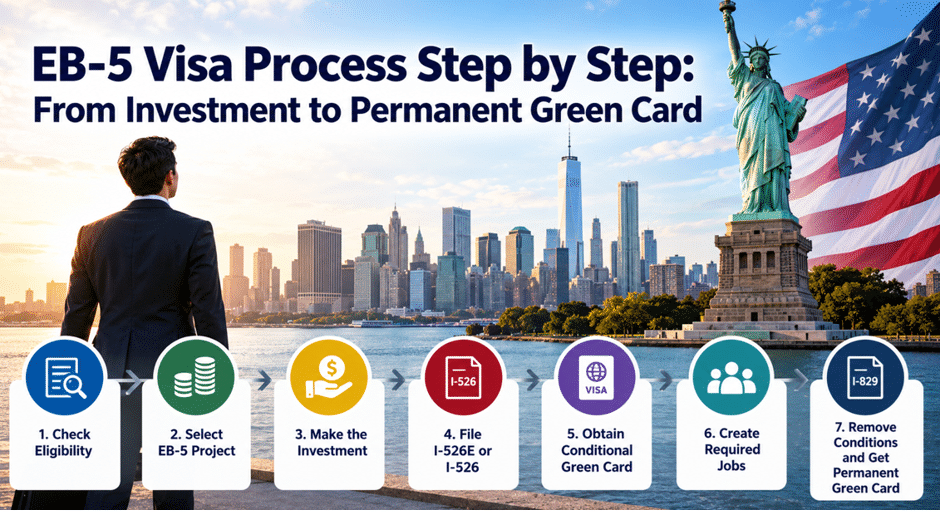
The EB-5 Immigrant Investor Program offers a pathway to U.S. permanent residence for eligible foreign investors who make a qualifying investment in a U.S. commercial enterprise and satisfy the required job-creation rules. However, the process involves much more than simply transferring money into a U.S. project.
For investors considering this immigration route, understanding the EB-5 visa process step by step from investment to green card can make the overall journey easier to understand and plan.
Step 1: Determine EB-5 Eligibility
The first stage is determining whether the investor meets the basic EB-5 requirements.
Under the current EB-5 framework, the required investment is generally $1.05 million, or $800,000 when the investment qualifies for the reduced amount applicable to certain targeted employment areas or qualifying infrastructure projects.
The investment must be made in a qualifying new commercial enterprise, and the required capital must be placed at risk for the purpose of generating a return. The investor must also demonstrate that the capital came from a lawful source.
Source-of-funds documentation is therefore an important part of the case. Depending on the investor’s circumstances, evidence may include tax records, salary records, business documents, property-sale records, bank statements, loan documents, inheritance records, or other financial records.
Step 2: Select an EB-5 Investment Project
Once eligibility is established, the investor needs to identify a suitable EB-5 project.
Many investors participate through a USCIS-designated regional center. Regional center projects can provide a structured investment opportunity and may allow qualifying indirect job creation to satisfy the employment requirement.
Investors should carefully review the project’s business plan, financial structure, expected job creation, investment documents, exit strategy, and associated risks before committing capital.
The immigration requirements and the financial merits of an investment are separate considerations. Approval of an EB-5 petition does not guarantee that an investor will receive a financial return.
Step 3: Make the Investment and Document the Source of Funds
The investor then transfers or commits the required capital according to the investment structure.
USCIS requires evidence showing where the investment funds came from and how they moved from their original source into the EB-5 investment. Maintaining a clear financial trail is particularly important.
For example, if funds originated from the sale of property, the investor may need to document ownership of the property, the sale transaction, receipt of the proceeds, and subsequent transfer of those funds.
Step 4: File Form I-526E or Form I-526
The next major stage is filing the appropriate immigrant petition with USCIS.
Investors participating in a regional center project generally file Form I-526E, Immigrant Petition by Regional Center Investor. Standalone investors generally use Form I-526, Immigrant Petition by Standalone Investor.
The petition package normally includes evidence concerning the investment, lawful source and path of funds, qualifying commercial enterprise, business plan, and job-creation requirements.
USCIS currently distinguishes between I-526E regional center petitions and I-526 standalone petitions. Processing times can vary considerably, so investors should check current USCIS processing information rather than relying on historical estimates.
Step 5: Apply for Conditional Permanent Residence
After USCIS approves the EB-5 petition, the investor proceeds toward obtaining conditional permanent resident status, assuming an immigrant visa is available and the investor otherwise qualifies.
Applicants outside the United States generally proceed through immigrant visa processing with the Department of State. Eligible applicants already in the United States may be able to file for adjustment of status through Form I-485, depending on their circumstances and visa availability.
Once approved, the investor receives conditional permanent resident status for two years.
Step 6: Maintain the Investment and Meet the Job Requirement
During the conditional residence period, the investment must continue to satisfy the applicable EB-5 requirements.
A central requirement is the creation of at least 10 qualifying full-time jobs for eligible U.S. workers. For regional center investments, qualifying job creation can include indirect jobs under the applicable rules.
Investors should retain financial and project records throughout this period because documentation may later be required when seeking removal of the conditions.
Step 7: File Form I-829 to Remove Conditions
The final major stage of the EB-5 green card process is filing Form I-829, Petition by Investor to Remove Conditions on Permanent Resident Status.
The petition is generally filed during the 90-day period immediately before the second anniversary of the investor becoming a conditional permanent resident.
The investor must provide evidence demonstrating that the required capital was invested and sustained as required and that the required employment was created, or is expected to be created within the applicable period.
USCIS identifies evidence such as financial records, payroll records, tax documents, and other business documentation as potentially relevant to demonstrating compliance.
From EB-5 Investment to a Permanent Green Card
The EB-5 visa process is therefore a multi-stage immigration journey: eligibility assessment, project selection, investment and source-of-funds documentation, I-526E or I-526 filing, conditional permanent residence, maintenance of the investment and job creation, and finally the I-829 petition.
Because every investor’s financial history, investment structure, immigration circumstances, and documentation are different, careful preparation is important from the beginning.
Investors considering EB-5 should review the current USCIS requirements and obtain qualified professional guidance before making a substantial investment or filing an immigration petition.
